Monday, August 5, 2024

Seminars and Workshops for Fall

 Our speakers are excited to bring seminars back this fall. Bonsai classes are the first Saturday of each month, others are on Saturdays unless noted. Please see our Instagram and facebook pages for updates or call 410-527-0700. All are free to attend, requiring no pre-registration. 

September 7, 9 am      Bonsai Forest Planting Demonstration All bonsai classes are presented by Martha     Meehan of Meehan's Miniatures. 

Bonsai forest grouping
Saike, forest and slab grouping are the subjects of Martha Meehan's demonstration.  Learn how best to group and style bonsai while finding out which trees are most suitable for this project. 

 September 14, 9 am    Fall Garden and Container Designs Demonstration

Freshen up fall perennial gardens and containers with the addition of autumn blooms and color. We’ll also look at trees and shrubs to add to containers and landscapes now.

 September 28, 9 am    Fall Lawn Clinic

Brian Brannan, Garden Shop Manager
Fall is the BEST time to seed a new lawn or repair an existing one. Our experts will discuss which fertilizers, seed and weed control to use for fantastic results now and next spring.

 October 5, 9 am    Bonsai Show and Tell

 Bonsai from Kirstenbosch Botanical Gardens.
It’s your turn to take the stage and show us your own bonsai tree. Everyone is encouraged to share their projects, telling us a bit about them and bask in the glory of your accomplishments. The Plant of the Month will be determined from the Show and Tell today.

 Wednesday, October 2, 10 am    Arrival of the Giant Pumpkin

Seth unloading last year's "Aunt Lisa"
How big will it be this year? Over 1,000 pounds? 2,000 pounds? Be here when the Giant Pumpkin arrives! Guess how many seeds are in this year’s pumpkin and record it in our book. We will count the seeds on October 26 at noon to find the winner and award gift cards.

October 19, 11 am-4 pm      Ask the Expert---Bartlett Tree Experts
John is president of The Maryland Arborist Association

John Davis from Bartlett Tree Experts is here to answer any questions you may have about tree and shrub care, including pruning, insect and disease management and general landscape maintenance. Bring in photos, leaves or branches for a free diagnosis. Bartlett Tree Experts partner with Valley View Farms to provide care and information about trees and shrubs in our community.

 October 26, 12-2 pm    Owl-O-Ween

Kathy (second from left) and others from Phoenix Wildlife Center

Fascinated by owls? Join us for a close look at these magnificent birds and learn more about their habitat from Kathy Woods and volunteers from The Phoenix Wildlife Center. Phoenix Wildlife Center is dedicated to the rehabilitation and return to the wild of owls and other wildlife.

 October 26, 12 noon    Great Pumpkin Seed Contest


Tom, Tim and Nick

Tom Tasselmyer, WBAL's Chief Meteorologist, Laurie and other members of the Tasselmyer family, count the seeds in the giant pumpkin. Guesses have been made through the month. Once counted, we will find the winning guesses and award a $300. Valley View Farms Gift Card for 1st place, $200. for 2nd and $100. for 3rd. Good luck to all!

November 2, 9 am    Winter Bonsai Care


As Old Man Winter approaches, care of both indoor and outdoor bonsai take center stage. Martha will discuss methods used to keep bonsai happy and healthy through the next few months. Our Plants of the Month are Citrus.

 November 2, 11 am    Winterizing the Water Garden

Winter is just around the corner. Tim McQuaid will provide tips to keep the pond healthy, the fish safe and the plants resting until the spring thaw.

 December 7, 9 am     Bonsai--- All about Pines

Martha Meehan will identify various types of pines and discuss their unique characteristics and care. Our Plant of the Month-- you guessed it, Pine.

 December 7, 11 am    Winter Porch Pot Designs

Join us for some ideas on how to create container evergreen designs and displays that will knock your stockings off just in time for holiday decorating outside. Guest speaker Claire Jones provides our inspiration.

Please join us and share ideas that you may have for future seminars and speakers. Thank you. 


Tuesday, July 23, 2024

Horticulture's Premier International Meeting Columbus, Ohio 2024

 Cultivate '24 has come to an end. This amazing horticultural trade show, education venue, and networking event is an annual tradition for our grower, John Miller and me. We look for trends, new and improved plants, better ways to display, how to interact with social media and so much more. Here are some of the things we did over the 4 days of the event. 

On day 1, an all day workshop on creating content and sharing it on social media was attended by people from all over the U S and the world. Led by Kate Dubow, Clint Albin, Katie Elzer-Peters and Maria Failla,

we toured a cool garden center, Groovy Plants Ranch, first. It's hard not to compare this grower/garden center with our own. Their site was flat, (ours is not), and concentrated on houseplants, succulents, annuals, tropicals and a limited selection of  perennials. Easy to navigate and full of surprises, it was a joy to tour and talk about with the owners and members of our group. I've been here several times and have watched it grow. Groovy Plants Ranch lives up to its name creating a groovy vibe in it's surroundings. 
Beautiful gardens border the entrance...love the VW bus

This beetle has a fairy garden 


A potting area for DIYers 

One of my team members

Worth a visit 

We boarded the bus and headed to an award-winning landscapers' home.  Nick and Allison McCullough allowed us into their home landscape to view a remarkable site where entertainment areas, vegetable gardens, and other areas had their own 'rooms' divided by walls of green. 
Landscaper Nick McCullough

Nick says the lawn will go as his children grow; for now it serves as a play area for them between all the garden spaces at their home and their parents' home next door. 

Border planting between neighbors (family)

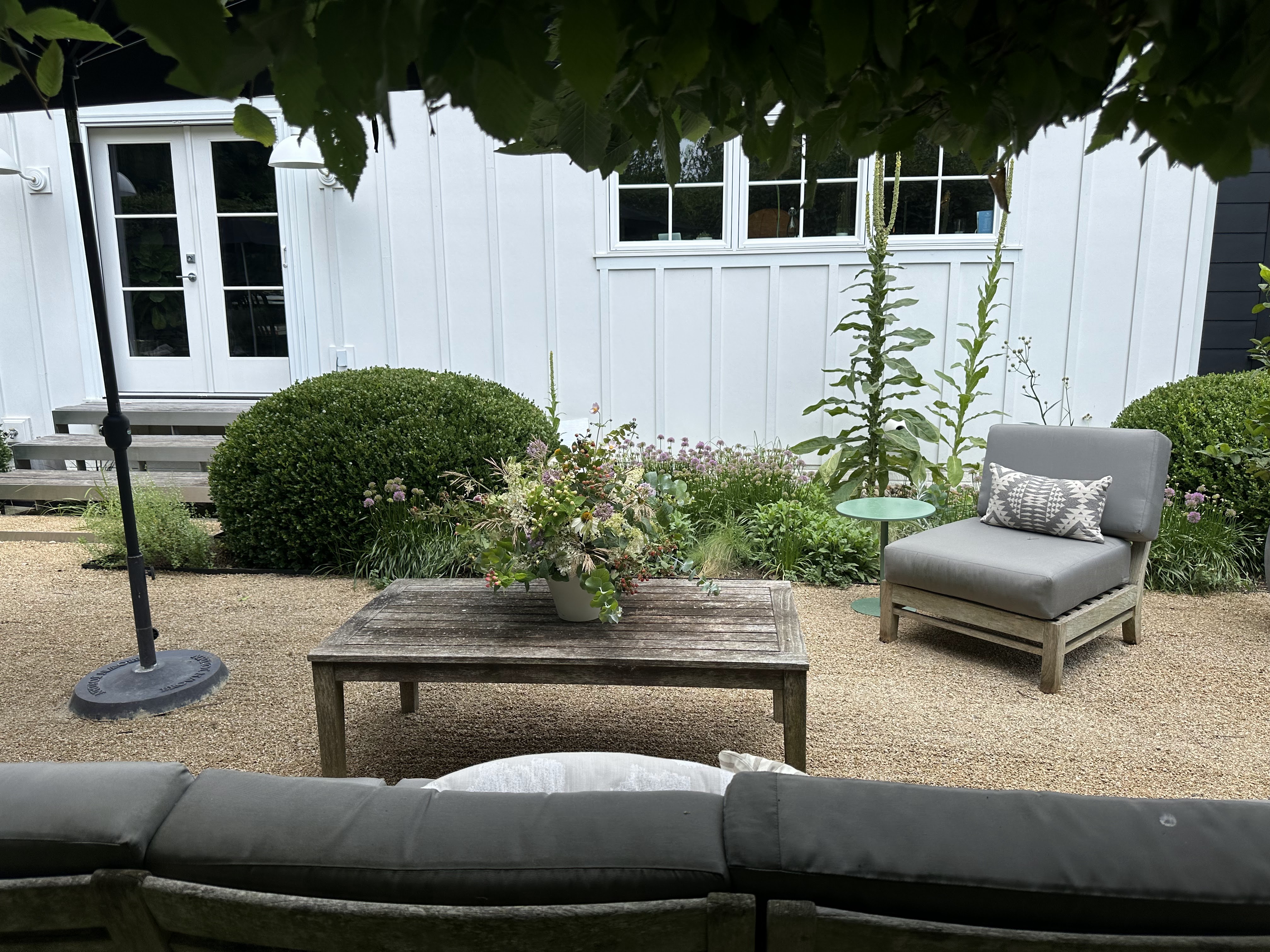
The landscape is still young. I loved their use of strong foliage elements in the containers and the color palate of green, gray and burgundy/purple. This unified the yard and house time after time. 
Loved the purple and gray accent plants and planters 

Foliage first for color, texture and design

Easy to maintain plantings between walkway and house

More gray accents with watering cans

Seating in the shade under topiary tree planting

Fun metal accents throughout the landscapes

Living walls open to a bridge to Mom's house

Upon our return to the convention center, we all shared Instagram stories and reels from our visits to the two stops earlier in the day. 
Up next, I will share some plant photos from the show and from our local trial gardens.
Mom's garden is beautiful as well 

 This book, authored by our hosts, provides wonderful inspiration to those of us who wish for help in designing our own home gardens. 


Sunday, July 7, 2024

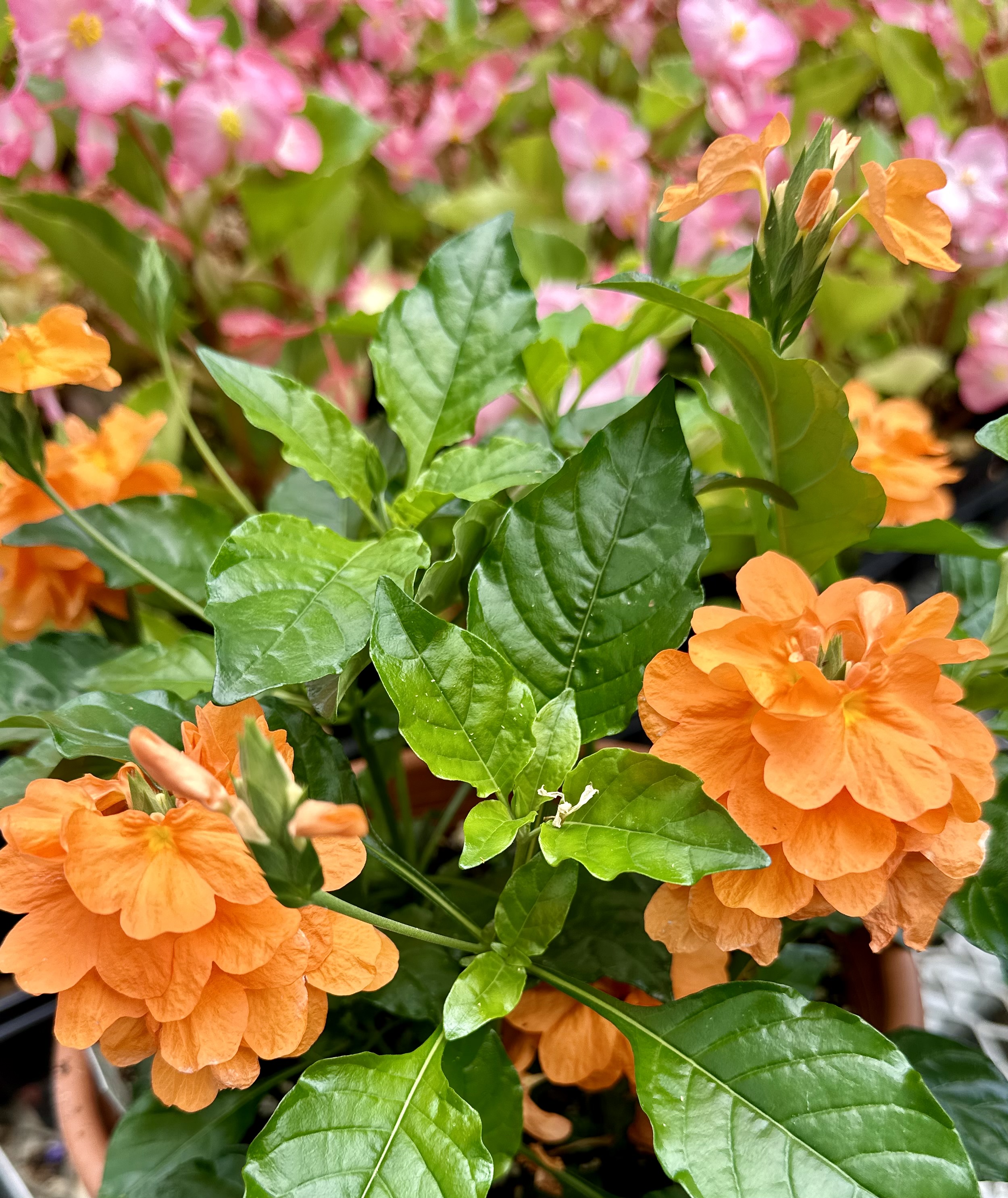
Plant of the Week: Crossandra infundibuliformis AKA Firecracker Flower

Summer heat has arrived and decided to stick around. So did the need to have beautiful, heat-loving annual flowers that bloom all summer. Lantana, vinca, scaevola, purslane, and many other flowers handle the heat, but my favorite is the Crossandra Orange Marmalade.

The brilliant orange flower atop dark, shiny green leaves is a must have in my garden. What better way for a plant-loving Baltimore Orioles' fan to show her support for the local baseball team!


Let's go O's!

Yep, I love my O's and my bright orange Crossandra. Both are sure to have winning seasons this summer! They're all all-stars in my book! 

Height: 8-10"

Love the glossy foliage with the bright orange flower

Space: 10"

Water: When soil is dry to the touch

Fertilize: Every other week when growing in containers

Sometimes available in watermelon and yellow colored blooms, but, obviously, orange is my favorite! 

Tuesday, June 18, 2024

Plant of the Week: Oak Leaf Hydrangea, Hydrangea quercifolia

A shady spot perfect for Oakleaf Hydrangeas
 
Oakleaf Hydrangeas are an excellent choice for a large shrub in a shady or sunny area of the garden and landscape. Huge cone-shaped flowers may be as long as 12 inches. They fade from pure white to an antique shade of pink as summer gives way to autumn. 

Fading late summer flowers

The spectacular large, oakleaf-shaped leaves change from green to garnet red in the fall. Peeling bark on the stems add even more interest to this already fascinating shrub. 

I admit that left alone, the Hydrangea quercifolia can get too large for some areas. One planted at the edge of my stone rancher has grown well passed the roofline, needing to be trimmed back occasionally. Planted in the proper area, they do not require pruning and bloom reliably year after year. In addition, there are dwarf varieties, including one called Munchkin, that top out at 3 feet with a spread of about 4 feet. Other varieties range in size from 5-7 feet. Take a look at the Plant Finder tool on our website for more information on the many varieties we are likely to carry. 


'Munchkin', a compact variety

'Snow Flake' Oakleaf Hydrangea

The broad leaf multi-stemmed shrub has an upright spreading habit. Its leaves contrast well with evergreens, both broadleaved and needled. In my own garden, it is planted with  Variegated False Holly, Osmanthus heterophyllus 'Goshiki',  and Plum Yew, Cephalotaxus harringtonia ' Fastigiata'. The bed also has perennial ferns, hostas and hellebores. The foundation plants were chosen for shade tolerance, foliage compatibility, and, with the exception of the hostas, deer resistance. 

Hydrangea 'Munchkin' in our sales yard

Plum Yew is a great companion plant

False Holly offers mottled leaves with yellow coloring

It did not take long for the Oakleaf Hydrangea to fill up a large space. I expect them to outlive me as they seem very happy in their garden setting. They have not attracted any insect pests in the 10 years they've been in my landscape. I like that they and the ferns planted in the bed easily self-propagate and cover the soil without the need for mulch. Do mulch them if they are out in the open, especially with a 1/2 day or more of sun. These hydrangeas are hardy to USDA Zone 5A and are native to our area. 

The flowers are excellent for cutting anytime as they fade from white with some pink edging to the dusty pink later in the year. For crafting, they make beautiful wreaths for the fall. 

Hydrangea Wreath photo courtesy Fine Gardening magazine

Do consider Oakleaf Hydrangeas for your garden. I've been very pleased with mine. 

The photos in this blog are mine or from Plant Finder on our website unless otherwise credited. 

Friday, June 14, 2024

June is National Pollinator Month -Pollinator Week is June 17-23

Monarch butterfly feeding on Solidago, Goldenrod, as it migrates through Maine.

 It's National Pollinator Month! We've learned so much about pollinators. We are as dependent on them as they are on us. We realize that one of every three bites of food we have is a result of the pollination of vegetables and fruits.  

How do we decide what to grow for our pollinators? 

Provide diverse plantings that bloom throughout the growing season. consider plants like Clethra and  Echinacea (coneflowers) for the summer and Solidago (goldenrod) for the fall. 


Clethra attracted swarms of Swallowtails to my garden
 
Think Native Plants. We have gotten better about promoting native plants that adapt to local climate and soil, attract wildlife, and are beneficial to native pollinators. Use Rudbeckia, Black-eyed Susan's, Maryland's state flower for summer plants. I love Mertensia virginica, Virginia Bluebells, for early spring, and Eutrochium purpureum, Joe-Pye weed for a fall native perennial. 

Lobelia cardinalis growing in shade 


Swallowtail and Bumblebee share the wealth provided by Joe-Pye weed

It's ok to plant annuals. Lantana, Salvia, Cuphea, Zinnia, and scores of other annuals provide nectar all summer for pollinators that we might attract to our vegetable gardens. Herbs are important too. I plant several 'sacrificial' parsley plants every year to feed Swallowtail butterflies. 

Hummingbird taking a break atop a dahlia

Avoid pesticides to protect pollinators. If an unwanted plant has become a major issue, consider removing it manually. For things like poison ivy, cut the plant back and treat the cut-end with Stump and Vine Killer, which works without having to spray a pesticide. I use the same practice to eradicate Tree of Heaven, the invasive host plant for Spotted Lantern Flies. 

Tree of Heaven Photo from University of MD Extension

Paint the cut of the unwanted plant for control. Use for Poison Ivy, English Ivy, Tree of Heaven. 

Provide water. In birdbaths, leave a stone in the bath to allow for perching. Fill shallow saucers with sand and water for butterflies. Put in a small pond to attract frogs and dragonflies. Your yard's diversity creates diversity in the pollinators you attract. Do be careful of standing water as we don't want to attract mosquitos. I add Mosquito Dunks to birdbaths and shallow pools to prevent them. The Dunks do not harm other wildlife. 


Provide shelter from predators in the form of small trees, perennial beds, hedgerows along fence lines and vines growing on vertical structures.

Don't keep the garden too tidy. This is my favorite tip. I've noticed bees in old firewood, and woodpeckers in dead trees.  Some bare ground will provide habitat for soil-aerating ground-nesting bees. Pollinators like weeds too.

The University of Maryland Extension provides more excellent information on the subject.

Visit us during June for an extensive choice of Plants for Pollinators!