Friday, July 17, 2015

PLANT OF THE WEEK: Quickfire™ Hydrangea

Hydrangeas are looking particularly beautiful this year, on our nursery lot and in gardens throughout our area. It seems like the perfect time to talk about these wonderful shrubs. John Collins and I just returned from filming several Sunday Gardener episodes that we were able to do on location at a property in Parkton, MD. The owners, Andy and Kristen, have planted over 50 hydrangeas along the perimeter of their wooded areas.
A perfect setting for hydrangeas
 They are blooming in all their glory right now! Lacecaps, mopheads, oakleaf types; you name it, they are spectacular. We brought a Quickfire™ hydrangea with us for the shoot to talk about planting, pruning, and to show how blooms can age gracefully providing color for several seasons. Upon returning to the store, we spotted this beauty, potted in a large container at our driveway's entrance.

One of the planted large containers at Valley View's entrance

You can see how the bloom ages from a bright white to a pink color. By fall, the bloom will be rosy-red, providing just the right hue for the season.

White deepens to pink and eventually a rosy red

Quickfire™ Hydrangea is a Proven Winners shrub
Give hydrangeas plenty of space. The Quickfire™ can grow over 8 feet tall and wide. They can be grown in hedges, but I prefer to see these shapely shrubs set apart from one another. Prune this variety in late winter to early spring as it blooms on new wood. Provide at least a half day of sun; Quickfire™ will thrive in full sun as well. This hydrangea is adaptable to various soil conditions and will grow as well in urban areas as it has in Andy's rural landscape.
Maybe one will find a new home in my yard!

Friday, July 10, 2015

PLANT OF THE WEEK: Hay-scented Fern

Hay-scented ferns greeted us as we headed down Andy's driveway to film this week's segment of The Sunday Gardener for WBAL. The forest setting was a lush green; the ferns set in an open glade dappled by the morning sun. The hay-scented ferns have colonized in an open area surrounded by other plants and trees in this beautiful setting in northern Baltimore County.
A colony of Hay-scented ferns
Dennstaedtia punctilobula, (Eastern hay-scented fern), is a native fern that grows to 1-2 feet in height and spreads to 2-3 feet. When planting a new bed, leave a space of 2 feet or so between plants. The hay-scented ferns grow and reproduce rapidly, indicating that they would like a large area to colonize and may be too large for a smaller garden space. The fronds are a yellowish-green, and very fine textured with a slightly 'hairy' surface. They can also be used singly in the right area.

Stumped for what to plant? Here's an idea!

 The common name comes from the scent of newly mown hay when the fronds are crushed beneath ones feet or between fingers.
Hay-scented ferns are deer resistant. The ferns are attractive when used as a groundcover, requiring light to medium shade. They are also a valuable plant for erosion control along shady slopes or hillsides.
The wooded property had many areas where other varieties of ferns were thriving in the landscape. Look for the tremendous variety of ferns available in the shady aisles of our perennial department.

Tuesday, June 30, 2015

PLANT OF THE WEEK: Vietnamese Water Jasmine


Native to the tropical regions of Africa, Asia and Australia, Wrightia religiosa can also be grown successfully in the southern US, It is most often seen in bonsai form. Though not related to jasmine, the flowers produce a sweet honey scent that can easily fill a room. Clusters of white flowers hang beneath the leaves of the tree and can last for weeks at a time.
Sweetly scented flowers
While the name suggests that this plant would love water, it is very easy to over-water. If you cannot keep the soil evenly moist, I recommend letting the plant dry out. My personal Wrightia goes into full wilt before I water. Full to part sun and regular fertilizing during the growing season are essential.

Vietnamese Water Jasmine trained as bonsai


Though I love this plant for its graceful structure and the fragrance, the stories that I have heard, and the little hint of mystery surrounding it, make it my favorite. Also known as Sacred Buddhist, throughout my research, I never found the reason it was given this name. Instead I was told that the name, water jasmine, came from the plant’s natural habit of growing out over water. When the plant bloomed, the flowers would reflect from the surface of the water into the sky. During my research I also found a quick note about this plant flowering when it rained. Yet another reason it is called water jasmine? I’m not entirely sure, but after all the rain we had in June, my bonsai is blooming.

Wrightia religiosa is available as a starter plant in our greenhouse
Guest blogger Jen Kostick is a Maryland Master Gardener and bonsai enthusiast. She has worked at Valley View Farms for about 5 years, in our greenhouse in the spring and our International Christmas Shop in the fall. Jen has been assisting our bonsai grower, Martha Meehan, with our monthly meetings and workshops for the last few years.

Friday, June 26, 2015

PLANT OF THE WEEK: Gomphrena Pink Zazzle ™

Gomphrena Pink Zazzle in a mixed container

Mid to late summer blooming flowers need to be tough. They have to go through periods of drought, play well with others in mixed borders and containers and look good for the occasional summer barbecue when guests arrive. Gomphrena Pink Dazzle does not disappoint.

Gomphrena Pink Zazzle is a Proven Winners branded plant

Grow gomphrena in full to part sun. Pink Zazzle is a bit of a sprawler, so give it about 16" of space in a garden bed or plant it towards the edge of pots. The stiff, bristly bloom holds up for a very long time. The plant itself is drought tolerant and attractive to pollinators, including butterflies and hummingbirds.

Pink Zazzle in a pot at the edge of a garden bed greeted guests at a party held at Billy and Kay's house

We first saw this gomphrena in 2013 and decided to plant some up in pots for Breast Cancer Awareness that fall. We have the Susan B. Komen Race for the Cure in our area. The Pink Zazzle bloomed very well through September and October, enjoying the cooler fall months. Expect reliable bloom from June through October in Zone 7.


Tuesday, June 16, 2015

PLANT OF THE WEEK: Echibeckia Summerina™


Part of me just loves the name of this plant. The brand new series of Echibeckias is an inter-genetic cross between Rudbeckia and Echinacea. For those gardeners that aren't currently practicing their Latin, that's a cross between a black-eyed Susan and a cone flower.  Pat, our store gardener, has planted them along our sidewalk bed in front of our white house offices. The Echibeckia would love an exposure of full to part-sun. It is hardy in our area here in Baltimore County and will survive in USDA Zone 6. The daisy-like flowers are available in three colors this year; brown, orange and yellow, measuring about three inches across. The breeder , Pacific Plug and Liner, states that the plant has the appearance of Rudbeckia with the hardiness of Echinacea. We expect Echibeckia Summerina™ to bloom for two to three months in late spring to mid-summer.

Monday, June 8, 2015

PLANT OF THE WEEK: Cuphea Vermillionaire

Cuphea Vermillionaire from Proven Winners

Every once in a while, a plant comes along that everybody agrees is going to be a winner. The Cuphea Vermillionaire is that plant this year. We heard about it in trade magazines and various websites in 2014. By mid-summer, we had seen the cuphea in trials in Ohio and just north of us in Landisville, PA. The Cigar flower, one of many nicknames that this plant goes by, has been around for a long time. We'd never seen it hold up in such good bloom for so long during the spring, summer and fall seasons.
Also known as Firecracker flower, this cuphea can handle heat and tolerate drought once established. It will grow to about 2 feet and spread to 18 inches. Cuphea works well in container gardens and will attract hummingbirds to the home landscape. Vermillionaire combines the best of many worlds; a sun tolerant plant that is attractive in the garden, providing a different flower shape to gardeners and a color that works well in all gardening seasons. Try a few in your garden this year and let us now how they do.


Friday, May 29, 2015

Memorable May

Whew, what a month! The first two weeks of May were the busiest I remember working in over 40 years of retailing plants! Mothers' Day week is traditionally our busiest of the year, and 2015 did not disappoint. Thank you to our own growers and to those others who grew and supplied so many beautiful trees, shrubs, annuals and perennials. Water garden plants, tropical and vegetable plants have been as pretty as we've ever seen.

This spring has been interesting. We decided to stop selling and using a whole class of pesticides to help strengthen the pollinating bees, birds and butterflies in our area. Our customers were understanding and grateful to find safe alternatives.
We gave away 4,000 packets of sunflower seeds for the Great Sunflower Project to get kids to plant for the bees.

We have a core group of terrific employees, many whose service to Valley View Farms numbers in the decades. They did a terrific job of getting our new seasonal employees ready for spring. We were very pleased with our group of seasonal workers this year and hope to see many again in the fall and/or next spring.
Two veterans---Mark waters the ramp bed while Earl puts away shopping carts

Thank you to everyone who worked long shifts, changed their schedules to accommodate business and did everything possible to keep our products available, healthy and ready for our customers' homes.

And, last but certainly not least, thanks to all of our customers who came out day after day to purchase products, ask questions and, most of all, trust us to deliver quality merchandise and advice.
We enjoyed seeing our 'regulars' and meeting new customers all season.
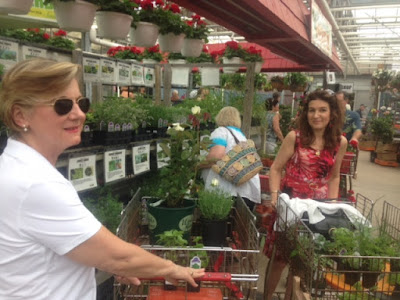
Checking out our herb selection
Sally and her favorite rake


This family of 4 (there is a little guy hiding behind Dad) chooses their plants ---Hey, there's Mark again!
We are still growing fresh plants and receiving goods from area growers and suppliers. We are in no way finished with the season. Our year-round location will continue to strive to be the best garden center ever, thanks to all of the aforementioned people. We've come a long way.

Where it all began.


Have a great summer! See you soon.